
HKIAIA · Frontiers in Youth Dialogue | From Zurich to Geneva: A Tsinghua AI Youth Team’s Perspective on Global AI Governance
- Published
- 09/09/2026 15:00
- Type
- —
- Reading time
- 9 min read
【HKIAIA · Frontiers in Youth Dialogue】Artificial intelligence is rapidly moving beyond the laboratory and into industry and society. As model capabilities continue to advance, the global conversation is shifting from what AI can do to how it should be used. Safety, fairness, ethics, standards and international collaboration are becoming central issues in the development of AI. In this process, young technology talent are not only experiencing the transformation first-hand, but are also emerging as a new force in technological innovation and global dialogue.
Recently, the Hong Kong Information and Artificial Intelligence Association (HKIAIA), through its “Frontiers in Youth Dialogue” series, spoke with Allen Liu (Liu Shuaize), a student at Tsinghua University’s Institute for Interdisciplinary Information Sciences, leader of the “Ruizhi Xincheng” Switzerland field study team, and Student Executive Council Member of HKIAIA. The discussion focused on the team’s research into AI governance in Switzerland, global technology collaboration and the participation of Chinese youth.
From the research frontier in Zurich to international organisations and street-level conversations in Geneva, the experience spanned technology, society and governance, prompting a young AI student to reconsider a fundamental question: as technology continues to advance, how should young people understand the future—and how can they help shape it?
![[object Object]](https://static.hkiaia.com/hkiaia-homepage/media/0bf6ba185f7fb52c59e0e09c4cb573a4-2-300x200.png)
▲ Figure 1:Allen Liu (Liu Shuaize), Executive Council Member of HKIAIA, student at Tsinghua University’s Institute for Interdisciplinary Information Sciences, and Leader of the “Ruizhi Xincheng” Switzerland Field Study Team.
From Technology to AI Governance
As a student at Tsinghua University’s Institute for Interdisciplinary Information Sciences, Liu was most familiar with algorithms, models and technology itself. While preparing for the overseas field study, however, he and his team broadened their focus beyond technological breakthroughs to AI Governance.
In his view, leading AI technologies will ultimately leave the laboratory and enter the real world. As AI capabilities continue to grow, it is no longer enough to ask what the technology can do. Questions of safety, fairness, privacy, ethics and accountability—and how technology can genuinely serve society—are equally important for technology researchers.
This was also a key reason why the “Ruizhi Xincheng” team chose Switzerland.
Switzerland is home to internationally renowned science and engineering institutions such as ETH Zurich and EPFL, while Geneva hosts major international bodies including the International Telecommunication Union (ITU) and the International Organization for Standardization (ISO). Researchers, businesses, international organisations, technical communities and youth representatives converge there, making Switzerland a distinctive vantage point from which to observe both the frontier of AI technology and global governance collaboration. Liu likewise saw Switzerland as a place where research innovation and international governance could be examined side by side.
“We wanted to understand how different countries and institutions view the development of AI,” Liu said. “Beyond competition, can we continue to communicate? Amid differences, can we continue to seek common ground?” With these questions in mind, he and 12 team members formed the “Ruizhi Xincheng” overseas field study team and embarked on an 11-day programme in Switzerland.
![[object Object]](https://static.hkiaia.com/hkiaia-homepage/media/453e8d9ddf0d954367d7fadb25183250-1-300x200.png)
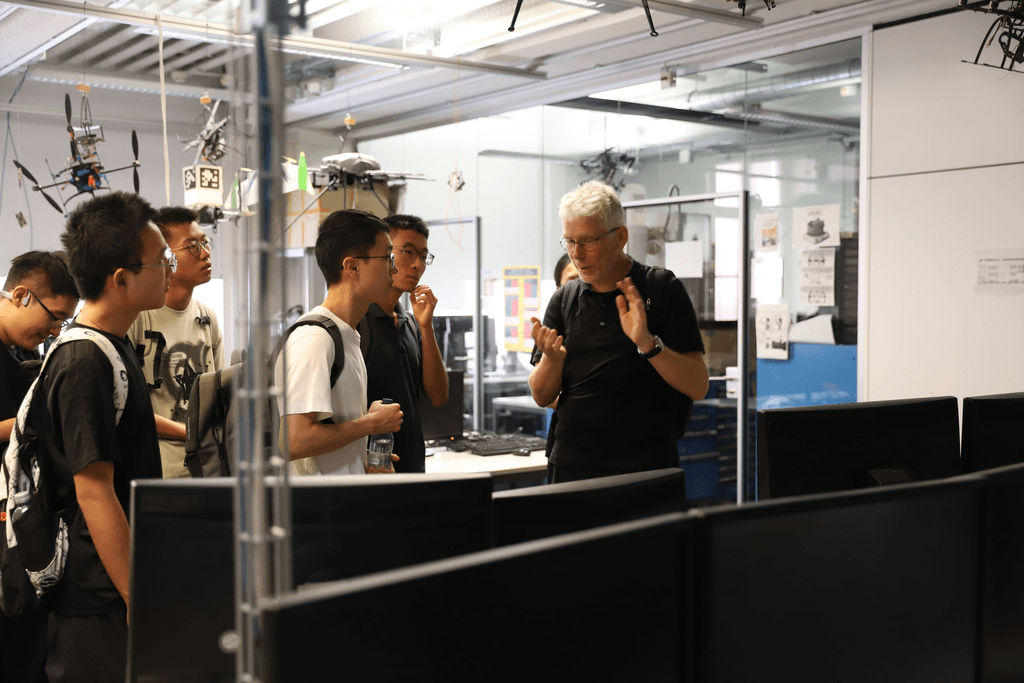
▲ Figure 2:The team visited ETH Zurich to gain insights into frontier AI research and the latest technological developments.
From Zurich to Geneva: Two Sides of the AI Landscape
Zurich and Geneva offered two distinct perspectives on the team’s research.
In Zurich, the team visited ETH on several occasions, engaged with scholars in artificial intelligence, and organised an AI forum for Tsinghua alumni. From frontier research in computer vision to industrial AI applications and international collaboration, the team observed at close range how technological innovation continues to expand the boundaries of AI capability.
In Geneva, the focus began to shift. The team engaged with organisations involved in global internet and AI governance and international standard-setting, including the IGF, ITU, ISO and IEC, and also exchanged views with international organisations such as WMO, UNDP and IFRC. Their respective work across standards, infrastructure, public governance and social applications revealed another dimension of AI development: beyond technological innovation, progress also requires rules, standards, social responsibility and international collaboration.
Liu summarised the contrast this way: “Zurich showed me how far technology can go. Geneva made me think about why it should go that far, and where it should ultimately lead.” In public-interest applications such as disaster early warning, for example, AI forecasting is only one part of the system. From global meteorological data and communications standards to whether information can actually reach local communities, multiple institutions must work together before technology can generate meaningful social value.
This led Liu and his team to recognise that AI governance is not simply about “controlling technology”. Rather, it is about advancing innovation while keeping it connected to human needs, social value and public responsibility.
AI Governance Should Not Be a Conversation for the Few
Why bring ordinary people’s voices into a study of AI governance?
Liu’s response was simple: “Who should write the answers to AI governance?”
Technology experts focus on capability boundaries, companies on real-world deployment, governments on the public interest, while ordinary users experience the effects of technology directly. If discussions about the future of AI remain confined to a small group of specialists, they are unlikely to fully respond to the needs of society.
One interviewee told the team, “Think about other humans. Think about humanity.” Another observed, “Technology is political.” These street-level perspectives made the team more acutely aware that AI governance is not an issue solely for scientists, engineers or policymakers. AI affects everyone, and discussion about its future therefore requires broader and more diverse social participation.
![[object Object]](https://static.hkiaia.com/hkiaia-homepage/media/a3dd9985d28ffb95b2c2e47d90b88156-1-300x225.png)
▲ Figure 3:The team took to the streets of Geneva to hear diverse perspectives on the development and governance of artificial intelligence.
Chinese Youth: From Seeing the World to Participating in It
In international exchange, young people have traditionally been viewed primarily as learners—going abroad to understand the world and gain experience. Liu believes that on a global issue such as artificial intelligence, Chinese youth should also assume another role: that of participants.
Through their exchanges with international organisations, the team observed that multi-stakeholder participation has become an important feature of global technology governance. Governments, businesses, technical communities, academic institutions, civil society organisations and young people can all contribute in different ways to rule-making discussions and consensus-building.
Q: What can Chinese youth contribute to global AI governance?
Liu and his teammates believe that young people do not need to wait until they become professors, experts or corporate leaders before taking part. “We may not yet be able to propose a mature framework for AI governance, but we can begin by understanding how rules are formed and how different institutions collaborate. We can also show the world that Chinese youth are willing to participate in AI governance with an open mindset and discuss the future of artificial intelligence together with people and institutions from different countries.”
In Liu’s view, Chinese youth need to continuously strengthen their professional capabilities while also understanding industry, society and the international environment. They should listen to voices from around the world while proactively articulating the observations and perspectives of young people from China.
“Chinese youth can not only learn from the world; they can also help shape the future.” This has become one of the key messages the team hopes to carry forward after its Switzerland field study.
![[object Object]](https://static.hkiaia.com/hkiaia-homepage/media/f50e8542413a692efc62d962fcb95ba1-1-300x200.png)
▲ Figure 4:Through exchanges and dialogue at the WTO, Chinese youth moved beyond observing the world to actively engaging in global technology discussions.
From a Field Study to a Long-Term Platform for Youth Technology Exchange
After the 11-day programme, the team organised its research into a series of field-study features and interview videos, with the aim of bringing the global topic of AI governance closer to more young people. While looking for a platform capable of supporting longer-term exchange, Liu connected with the Hong Kong Information and Artificial Intelligence Association. Hong Kong’s distinctive position—rooted in China and connected to the world—also opened up new possibilities for youth technology exchange.
Q: What kind of platform do you hope HKIAIA can provide for young technology talent?
“I hope it will be more than a platform where young people express their views. It should genuinely connect young people with frontier technologies, industry practice and international exchange.”
In Liu’s view, young people need opportunities to engage with frontline research and understand genuine technological frontiers. They also need to enter technology companies and see how innovation moves from the laboratory into industry, while gaining more opportunities to participate in international technology exchanges and understand the issues shaping global AI.
He also hopes that, through HKIAIA, more sustained exchanges can be established with universities, research institutions, technology companies and international organisations, enabling more young people from China to move gradually from “understanding international issues” to “participating in international issues”.
This vision aligns with HKIAIA’s focus on the development of young technology talent: young people need to be heard, but they also need opportunities to be present where technological development is actually taking place.
HKIAIA Perspective | Connecting the Frontier and Enabling Youth to Be Present
From the research frontier in Zurich to international organisations and street-level conversations in Geneva, the field study reflects not only the growth of a young AI student, but also a significant shift in the development of artificial intelligence.
The future of AI will be shaped not only by breakthroughs in models, algorithms and technological capability, but also by industry practice, social needs, public governance and international collaboration.
Young technology talent therefore need not only to study technology and participate in research, but also to engage with industry, understand society and broaden their international outlook, developing a more complete perspective on technology and the world through real innovation and exchange.
This is also a direction that the Hong Kong Information and Artificial Intelligence Association continues to pursue:
To follow the frontier of artificial intelligence, connect the next generation of technology talent, and promote academic, industry and international exchange—enabling more young people to move from understanding technology and engaging with it to actively participating in its future.
Looking ahead, HKIAIA will continue to connect universities, research institutions, technology companies and young talent through frontier dialogues, academic exchange, visits to technology enterprises, industry engagement and international cooperation, creating more opportunities for young people to access the frontier, gain practical experience, express their perspectives and connect with the world.
Let young people see the future—and, more importantly, stand where the future is being shaped.
![[object Object]](https://static.hkiaia.com/hkiaia-homepage/media/8c0b2fcd3e83da34a8ac574e82668475-2-300x200.png)
▲ Figure 5:Connecting the frontiers of innovation with the world—empowering more young people to become participants, builders, and connectors in shaping the future of artificial intelligence.
Interviewee: Allen Liu (Liu Shuaize)
Text and Images Provided by: “Ruizhi Xincheng” Switzerland Field Study Team
Edited by: Hong Kong Information and Artificial Intelligence Association (HKIAIA)